


By Brendan Manson / President of Fellowship Development
When describing stewardship in a church capital campaign at the Steier Group we love the phrase “it is not equal giving, but equal sacrifice.” This is an important message that inspires the entire community to participate while not applying undue pressure on your community.
The 80-20 rule, or Pareto Principle, applies to campaigns. More than 80% of your funding will come from 20% or less of your community. Major donors will handle the majority of your funding. But it can be demoralizing to a major donor when the rest of the community doesn’t participate. The flip side is that for a small donor, a large gift or campaign goal could seem intimidating.
That’s why we counsel our partners to use gift range charts for donors. It provides everyone with the opportunity to give sacrificially but at a level that is within the donor’s means.
What is a Gift Range Chart? (And Why You Need One)
A gift range chart describes the different giving levels for a church capital campaign. These levels will be determined by the capacity of your community, the campaign goals, the expected number of donors and other important factors during the campaign planning phase.
There are two different types of gift charts to consider.
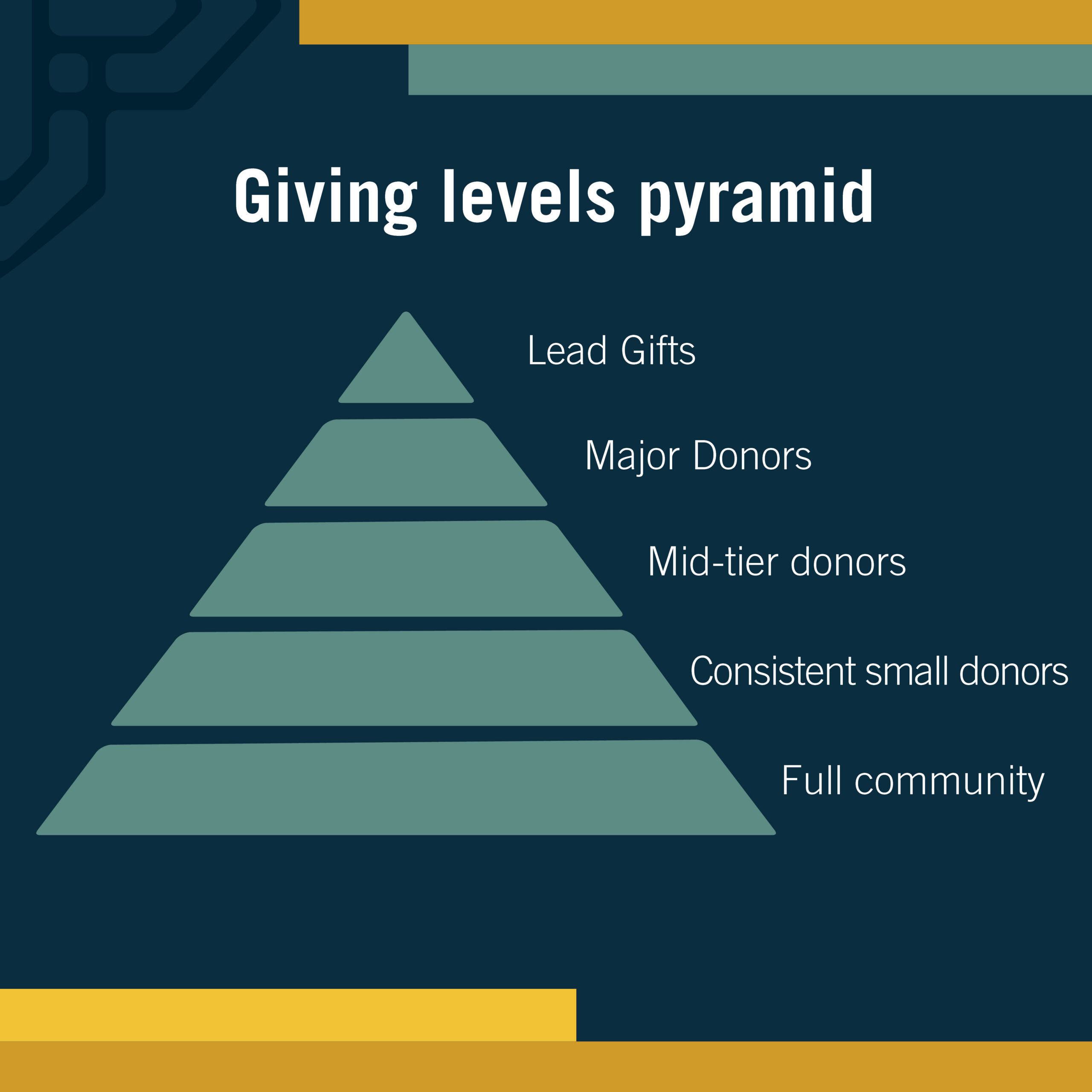
The internal approach looks at the different buckets in which you would sort your donors. Think of it like a pyramid. Your lead gift or gifts would be at the top, followed by your major donors, then middle tier donors and, finally, small dollar donors.
The external gift chart looks a little different. You don’t want to present a small dollar donor with the same gift chart as your lead donor. Talk about sticker shock! You would intimidate a donor without that giving capacity. And you risk inspiring a smaller donation from a lead giver if they see how low the chart goes.
At Fellowship Development, we suggest that donors receive a customized giving chart based on the data acquired and analyzed during the feasibility study.
Step-by-Step: How to Calculate Your Giving Levels
Setting up the appropriate giving levels and gift charts are vital for a successful campaign. Sometimes, a church or school will request that we avoid using a gift chart and it usually leads to a less successful effort. This is because it leaves the donation choice entirely in the hands of a donor. If you lead gift comes in at half of what you were expecting, that can make achieving your goals very challenging.
Here are the steps for determining the giving levels for your campaign:
Step 1: Determine your fundraising goal. When launching a capital campaign, setting an achievable yet challenging goal is key. Your community likely has lofty goals – building a new church, expanding ministries, adding STEM classrooms to your school or addressing long-needed maintenance. It can be easy to want to throw all your goals out there and challenge your community to cover the costs. But that is not realistic. A small church can’t expect to raise $10 million. Just as a large high school likely can’t raise $100 million. Use the data to inform your fundraising goal. Pressure test it against the number of active households in your community – can 500 families really hit that goal? Remember to make it challenging but achievable to set your community up for success.
Step 2: The Lead Gift. Depending on your community and the donation capacity at the top, your lead gift or gifts could amount to a sizeable portion of your fundraising goal. Maybe as much as 10-20%. Making sure that the gift chart is customized for this gift is important. You want to challenge your lead donor to give sacrificially. With especially large lead gifts, we often will create a customized packet for the donor. Any special touch can make the difference here.
Step 3: Major Donors. For most communities, there is a tier beyond the lead gift of major donors that can give a large amount. Depending on the size of your goals and the number of major donors you have, they may each receive a customized gift chart or a more general one that fits all of your donors at this level. After the lead gift, this is the most important bucket for donations to campaign. These donors should be asked for their support in person, preferably by a member of the church leadership. You could also host major donor events to engage this entire group and make an impression on them.
Step 4: Building the Middle. Although the bulk of your funds will come from your lead gift and major donors, it is important to not forget the donors in the middle. Donors at this level should still be asked for support in person, but likely by a campaign volunteer instead of the pastor or development director. While the individual gifts at this level will not have as big of an impact as in step 2 or 3, they will add up.
Step 5: The Wide Base. This group will include the majority of your community and amount to a smaller amount of gifts. Think the 20% or less of donations from 80% or more of your community. But that doesn’t mean this group of donors is any less important. At Fellowship Development, we strive to have high participation during a campaign. This isn’t so we can pat our clients on the back and give them a participation trophy. It is because community-wide buy-in for a campaign will help bring everyone together. And strong participation at the lowest level can inspire your major donors. If they see everyone in the community participating and giving in a sacrificial way, they are more likely to support at a high level.
Sample Giving Level Charts (Templates)
Here are some examples of giving level charts that you could use for your community. As a reminder, you don’t want to present every donor a chart that includes every giving level.
$1 Million Campaign
| Type of Gift | Giving Level | Number of Donors Needed |
|---|---|---|
| Lead Gift | $200,000 | 1 |
| Major Donors | $50,000 | 5 |
| Mid-Tier Donors | $10,000 | 10 |
| Small Donors | $5,000 | 100 |
$5 Million Campaign
| Type of Gift | Giving Level | Number of Donors Needed |
|---|---|---|
| Lead Gift | $500,000 | 1 |
| Major Donors | $200,000 | 5 |
| Mid-Tier Donors | $100,000 | 25 |
| Small Donors | $5,000 | 250 |
These are just potential examples. Every campaign will be different. Some may have a lead gift a lot higher than listed. Others may have a smaller lead gift and need to make up for that at the major donor or mid-tier donor level. The key thing to note is how many donors are needed. Each level is important.
How to Present Giving Levels to Donors
It is important to get the timing right when presenting giving levels to donors. Present it too early, when donors do not have as much buy-in to the campaign, and you could suppress participation. Present it late and you may present it after donors have already made an internal decision on how much they want to donate.
Internal planning: Internally, lock in the giving levels early in the campaign planning process. Use all the available data – feasibility study interviews, self-reported gifts, number of expected donors and wealth research – to inform your expected giving levels. Make sure that every level challenges donors to give at a sacrificial level.
Public materials: Publicly, you don’t want to share the giving levels early. Your lead donor and major donors should be approached with a customized gift chart during the silent phase of a campaign. There are two options: you could mail the materials to donors before meeting with them in person for making the ask or you could present the materials during your meeting and then give them time to consider their donation. Both work. Once the silent phase is done, you can share the giving levels publicly with all donors.
Psychology behind a gift chart: There’s a method to this approach. By presenting a donor with a range of potential gift options, you achieve two things:
- Set expectations: Especially for major donors, it is important to set expectations. A gift range with all six-figure gifts will inform the donor of what will help your community achieve their goals.
- Provide the illusion of choice: Psychologically, providing options provides donors the illusion of choice. Of course, they do have a choice. No one is forced to participate. But participation is valuable. An open-ended ask is dangerous. It allows donors to give much less than expected. But it can also put more pressure on a donor.
Naming opportunities: Another tool in the fundraisers toolbox is naming opportunities. You could set giving levels to achieve a naming opportunity. Say you are building a new church, you could present smaller donors with the opportunity to get their name on a brick in the entrance to the church. This could inspire higher giving from the low-end of your pyramid. At the high end, naming opportunities can be more general – like a Founders Circle plaque that highlights your major donors – or more specific – like the ability to name the new church hall after a donor. These opportunities can inspire donors to give more in order to honor their family and community.

Common Mistakes When Setting Levels
Throughout our firm’s long history of campaigns, we have seen many common mistakes when setting giving levels. Some examples:
- Flat Pyramid: Participation is important to a successful campaign, as described above. But you can’t expect your small donors to be the reason you reach a big goal. While small donations do add up, the Pareto Principle hammers home the importance of focusing your energy on the 20% that will give 80% of your funds.
- Launching campaign too early: Another mistake is to launch the public phase of the campaign too early. The silent or quiet phase of a campaign is key to a successful endeavor. During this time, you will be working to cultivate your lead gift and major donors. By doing this work ahead of a public launch, it allows you announce the campaign with fanfare. Imagine launching a campaign that has a $5 million goal and, on kickoff weekend, you can announce that more than $3 million has already been raised. That will inspire your smaller donors to participate! Now imagine the opposite scenario. You launch a $5 million campaign with only $500,000 raised during the silent phase. That can suppress donor participation because it seems unlikely the campaign will reach goal.
- Ignoring pledge duration: A campaign works on pledges, not immediate gifts, because it allows your church to raise more funds. A major donor may be able to commit to a $1 million pledge over three or five years, but could not make that same donation in just one year. Granting the flexibility of a longer pledge period allows for donors to be more comfortable giving at a higher level. If a church needs a big influx of funds to start construction or quickly pay off debt, you can certainly ask donors to pay a larger percentage of the pledge at first. Just make sure to explain why.
Conclusion: Using the Chart as a Spiritual Tool
For us at Fellowship Development, stewardship and engaging donors on a spiritual level is even more important than the true fundraising math. Our campaigns are meant to inspire stewardship, bring the community closer together and motivate a deeper spirituality.
It is possible that a gift chart could feel more like fundraising math than a spiritual approach. But we don’t believe that to be the case. At its heart, stewardship asks us to be good stewards of all that God has given to us. Inviting a donor to participate at a level that is sacrificial is quite spiritual. It allows a donor to fulfill their promise as a steward. After all, “God loves a cheerful giver.” (2 Cor. 9-17)
Frequently Asked Questions About Church Capital Campaign Giving Levels
How many giving levels should a church have?
This will depend on the size of the church and the size of the fundraising goal. But, ultimately, the gift pyramid for most churches should look the same. Use the pyramid and the data you have to create giving levels that work for your community.
What is a realistic lead gift?
This depends on the capacity of your lead donors. As mentioned above, a lead gift may account for 10-20% of your overall fundraising goal. For a small church without high giving capacity, maybe that means a lead gift of $100,000-$200,000. For a large church with high giving capacity and a large goal, that could mean a lead gift in the high six figures or low seven figures.
Should churches publicly share giving levels?
Yes and no. Transparency is important in fundraising. Your capital campaign communication should be clear and honest with your community. That said, there is no major benefit to sharing all your different giving levels with your entire community. Share the giving levels with the appropriate donors. Major donors or lead givers should receive the high end of the giving levels. Small donors should receive the low end of the chart.